Balinese Compound Living: Between Tradition, Privacy, and Modern Life
Balinese traditional houses, known as compound houses, are more than just homes. They are living ecosystems where family, culture, and daily rituals blend into one. But as modern lifestyles evolve, questions about privacy, personal freedom, and even mental well-being are becoming more relevant. This article explores how Balinese communal living works today, and how it adapts in a changing world.
When people think of Bali, they often picture beach clubs, luxury villas, or digital nomads working from cafés. But beyond that modern image lies something far deeper, and far more authentic: the traditional way of living rooted in Balinese culture.
At the heart of this lifestyle is the Balinese compound house, a unique residential concept that reflects not only architecture, but also how people live, interact, and belong to a community.
Unlike modern homes that prioritize privacy and individuality, Balinese compound living is built around togetherness, shared responsibilities, and cultural obligations.
So how does this system work in today’s world?
And how do Balinese people balance tradition with personal space and modern expectations?
Let’s explore.
What Is a Balinese Compound House?
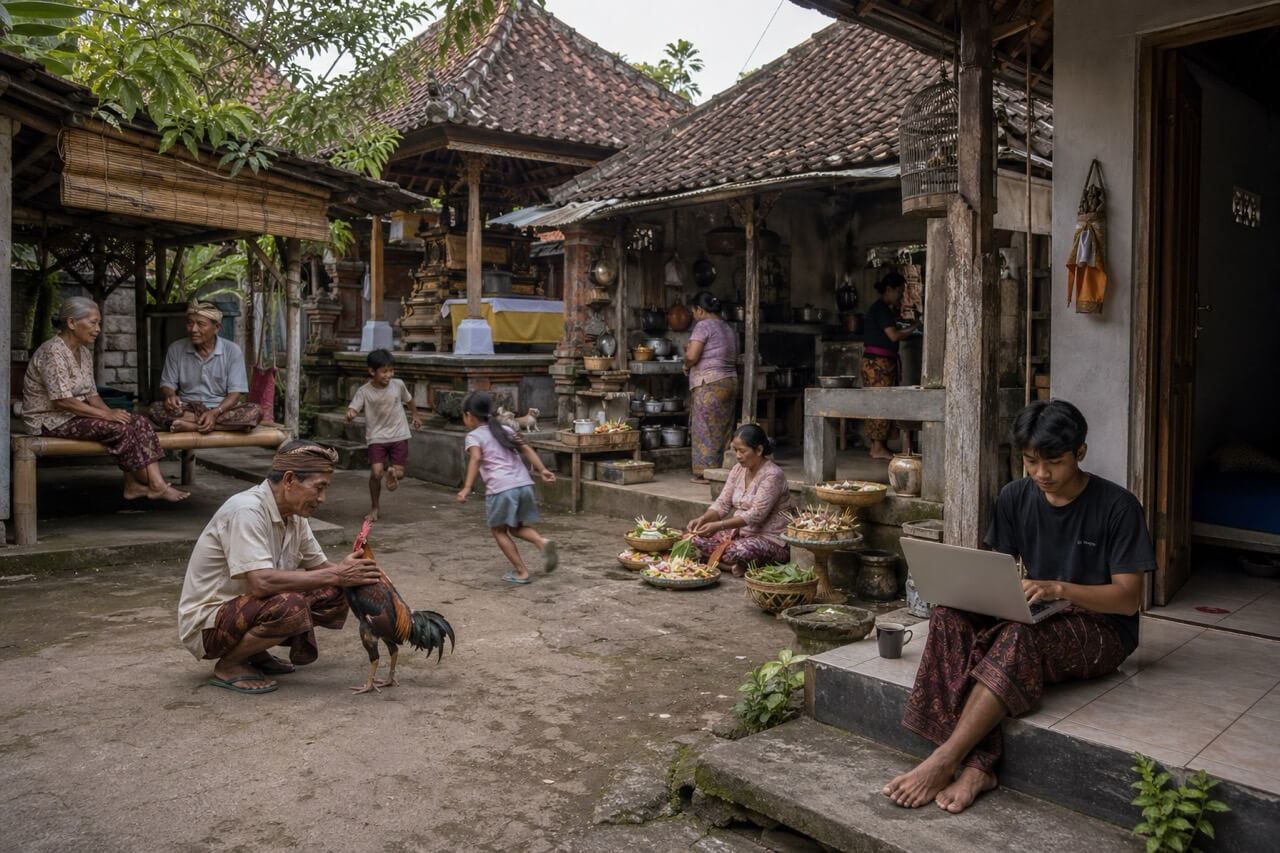
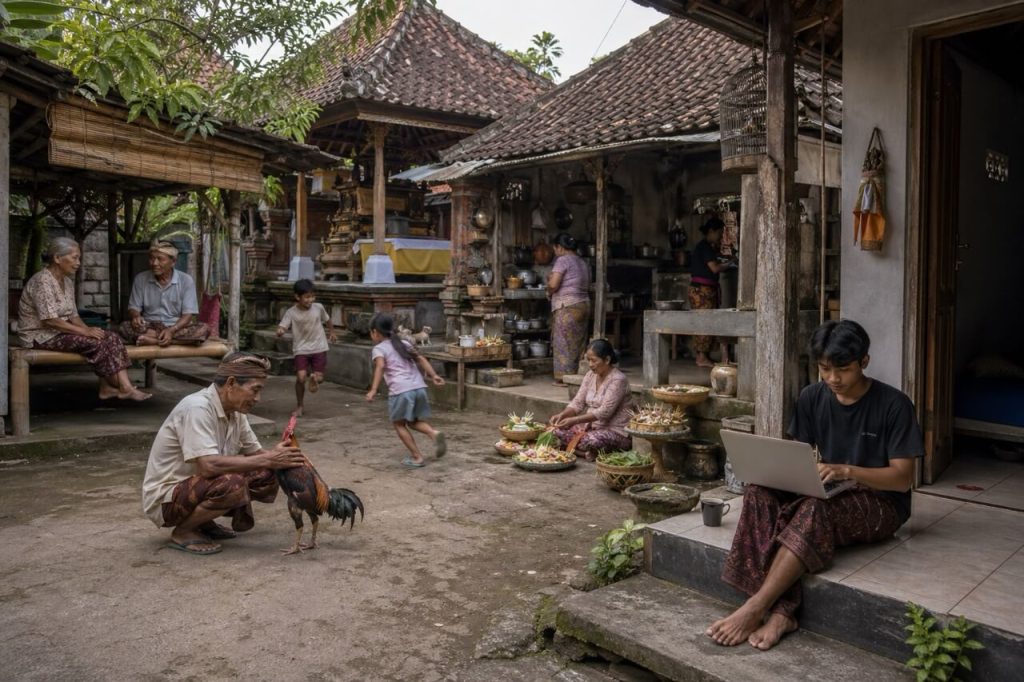
A traditional Balinese house is not a single building, it is a compound made up of several separate structures, each with its own purpose.
Typically, a compound includes:
- Bale dauh – guest or sleeping pavilion
- Bale dangin – ceremonial space
- Bale delod – family living area
- Paon – kitchen
- Sanggah or family temple – sacred spiritual space
The layout follows ancient principles known as Asta Kosala Kosali, a traditional guideline that organizes space based on spiritual balance and directional harmony.
One key difference from modern housing?
There is very little emphasis on strict privacy. Spaces are open, shared, and deeply interconnected.
Living Together: The Strength of Extended Families
In a Balinese compound, it is common to find:
- Parents
- Married children
- Grandchildren
- Sometimes extended relatives
This creates a strong multi-generational living system that offers:
Social Support
You are never alone. Family is always around to help.
Shared Responsibilities
Childcare, daily tasks, and even financial burdens are often shared.
Cultural Continuity
Traditions are passed down naturally through daily life.
In simple terms, loneliness is rare, but personal space can be limited.
Adat Obligations: A Way of Life
Living in Bali means being part of a broader social and cultural system.
Family Responsibilities
Each household maintains a family temple, requiring:
- Daily prayers
- Regular ceremonies
- Preparation of offerings (banten)
Banjar (Community Organization)
The banjar is the backbone of Balinese society.
Members are expected to:
- Participate in community work (ngayah)
- Attend meetings
- Contribute to ceremonies and events
Desa Adat (Customary Village)
On a larger scale, traditional villages regulate:
- Cultural events
- Social rules
- Community obligations
These responsibilities are not optional, they are an integral part of identity and belonging.
Where Is Personal Space?
Here’s where things become more complex.
In a highly communal system, privacy takes on a very different meaning.
Limited Physical Space
With multiple families sharing one compound:
- Rooms are limited
- Activities are often visible to others
- Quiet, personal space can be hard to find
Highly Visible Daily Life
Your routine is rarely private:
- When you leave or return
- Who visits you
- What you do
This creates a sense of closeness, but also constant awareness.
Social Expectations
There is subtle pressure to:
- Participate in all cultural duties
- Maintain family reputation
- Follow social norms
Choosing not to participate can lead to judgment or social distance.
The Younger Generation: Between Two Worlds
Today’s younger Balinese generation lives between:
- Traditional expectations
- Modern lifestyles and global exposure
This creates an ongoing question:
How do you honor tradition without losing your individuality?
Some choose to:
- Stay in the family compound but create personal boundaries
- Work outside to gain independence
Others:
- Move into private homes or urban areas
- Even leave Bali for opportunities elsewhere
Yet interestingly, most still return for ceremonies and family obligations.
The connection to culture remains strong, even when lifestyles change.
Mental Health: A Quiet but Growing Conversation
Mental health is a topic that has only recently begun to surface in discussions about Balinese life.
Communal living has two sides:
The Positive Side
- Strong emotional support
- Sense of belonging
- Cultural identity
The Challenging Side
- Limited privacy
- Social pressure
- Difficulty expressing individuality
Some emerging concerns include:
- Stress from continuous obligations
- Social fatigue
- Internal conflict between personal desires and cultural expectations
It’s important to note:
This doesn’t mean the system is flawed, rather, it highlights the need for adaptation in a modern context.
Modern Adaptation: A Culture That Evolves
Balinese culture is not static, it adapts.
Here are some changes happening today:
Hybrid Housing Designs
Modern compounds now include:
- More defined private spaces
- Enclosed rooms
- A blend of traditional and modern architecture
Flexible Participation
Younger generations are:
- Prioritizing certain ceremonies
- Managing time between work and adat
Awareness of Personal Boundaries
There is growing recognition that:
- Individuals need personal space
- Privacy does not equal disrespect
The Compound as a Social Ecosystem
From a modern viewpoint, a Balinese compound can be seen as a:
“Social ecosystem”
It includes:
- Support systems
- Cultural structures
- Spiritual practices
- Collective responsibilities
Interestingly, this resembles the concept of co-living, now trending globally.
The difference?
Bali has practiced it for centuries.
Why the World Is Paying Attention
In many modern cities:
- People feel isolated
- Social connections are weakening
- Individualism dominates
Meanwhile in Bali:
- Community remains strong
- Traditions are alive
- Relationships are deeply rooted
Yet, the challenge of balancing community and privacy is universal.
The Future of Balinese Living
Will this system survive?
Yes, but it will evolve.
Balinese compound living will likely:
- Remain culturally significant
- Adapt to modern needs
- Become more flexible for individuals
Because ultimately:
A culture survives not by staying the same, but by adapting.
A Balance That Isn’t Always Easy
Balinese compound houses represent a delicate balance:
- Between individual and community
- Between tradition and modern life
- Between obligation and freedom
They offer warmth, connection, and identity,
but also challenges that are often invisible from the outside.
In Bali, privacy is not a given.
It is something that must be negotiated within the rhythm of communal life.
And that’s what makes it so unique.
Bali is not just a destination.
It’s a way of living.

Author: Tira Triyana
A Balinese woman who is active in her daily life as a consultant & activist, also active in the PDI Perjuangan and leads several youth organizations, Women's Organizations and Children's Observers including Observers of the Disabled. Perempuan Bali yang kesehariannya adalah sebagai aktivis Pergerakan dan juga aktif di salah satu Partai Politik yaitu PDI Perjuangan dan memimpin beberapa organisasi kepemudaan, Organisasi Perempuan dan Pemerhati Anak-anak termasuk Pemerhati kaum Difabel.